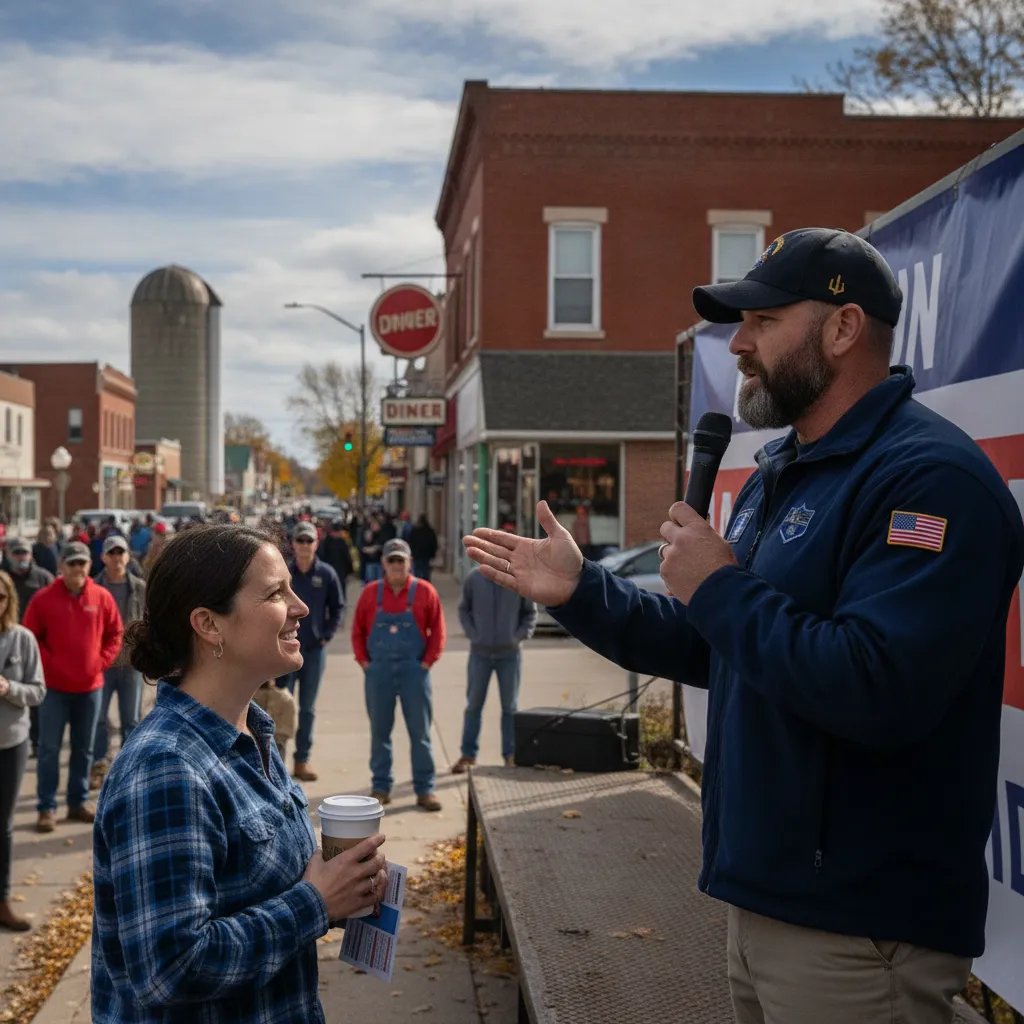
In the quiet stretches of Wisconsin’s 3rd Congressional District, where dairy farms meet small town main streets, a political battle is unfolding that may determine who controls the United States House of Representatives. Republican incumbent Derrick Van Orden and Democratic challenger Rebecca Cooke are locked in a rematch defined by familiar faces but escalating tensions. Both candidates lean heavily into their local roots to win over voters, with Van Orden highlighting his history as a Navy SEAL and family man while Cooke emphasizes her experience as a small business owner and waitress. Despite their different parties, they find rare common ground on local grievances, both opposing the construction of high voltage transmission lines and voicing skepticism toward massive data centers encroaching on precious farmland.
While they agree on protecting the backyard, they are worlds apart on the legacy of Donald Trump. Van Orden remains a steadfast ally of the former president, arguing that Trump’s patriotic resilience and economic policies, including tax breaks for seniors and tips, are fundamentally benefiting Americans. He views his bid for re-election as a necessary step to finalize critical legislation like the Farm Bill. Conversely, Cooke frames the Trump agenda as a catalyst for hardship in the district. She argues that foreign conflicts have driven up fuel and fertilizer costs for farmers and warns that previous trade tariffs damaged soybean and cranberry producers throughout the region.
Political observers suggest this specific contest serves as perhaps the ultimate bellwether for the national mood heading into November 3. David Helpap, a political science professor at UW-Green Bay, notes that while core enthusiasts remain loyal to their respective camps, the outcome hinges on fringe supporters who are weary of inflation and rising living costs. In a legislative environment where every single seat counts toward a majority, this narrow margin becomes magnified. Because Van Orden won their previous encounter by fewer than three percentage points, this race is no longer just about Western Wisconsin; it is a high stakes proxy war for national power.